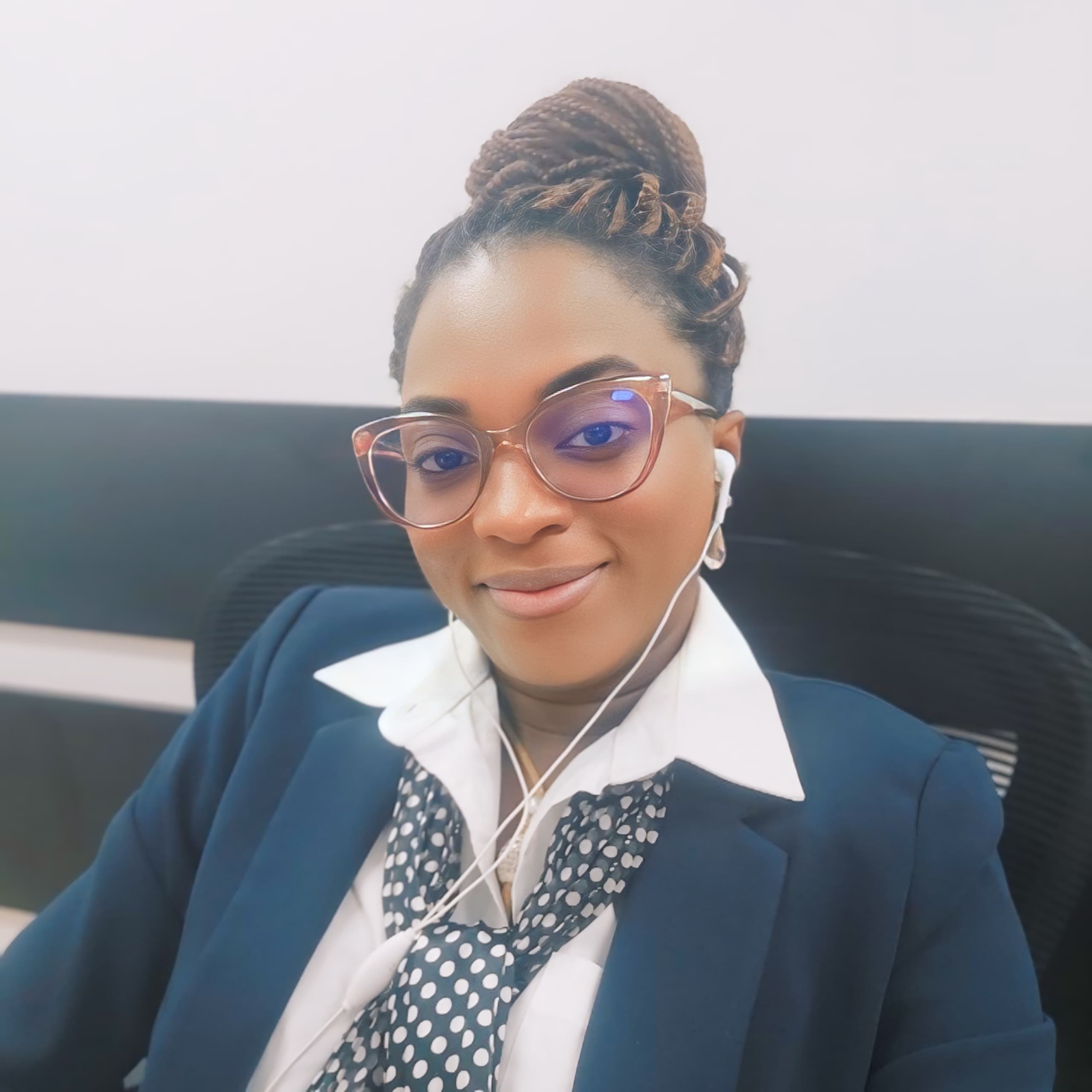
Upload a warm, personal photo of yourself or your persona.
Ideal size: 700×400px or 300×350px portrait. Should look like a real blog post photo.
Can I be honest with you for a second?
You have been working so hard.
Every morning, you open your phone or your laptop, scroll through the job boards — Jobberman, LinkedIn, Indeed — and you start applying. One by one. Tailoring cover letters. Adjusting your CV. Filling in those long application forms. Clicking submit.
And then… nothing.
Not even a rejection email. Just silence.
"Maybe they have not seen it yet."
You wait a few more days. Still nothing. So you apply again. More jobs. More applications. More silence.
Meanwhile, your phone is buzzing — but it is not a recruiter calling. It is your mother asking if you have found something. It is your friend sending a congratulations post they spotted on LinkedIn for someone you went to school with. Someone who — and you know this in your gut — is not more qualified than you.
"What do they know that I do not know?"
Maybe you have even updated your CV four or five times. Changed the font. Rearranged the sections. Asked a friend to review it. They made a few cosmetic changes. You sent it out again. Same result.
You have watched YouTube videos about "how to get a job in Nigeria." You have attended a webinar or two. You have read the articles. None of it produced a single phone call.
And late at night, when the house is quiet, a thought creeps in that you keep pushing away because it is too painful to look at directly:
"Maybe the problem is me."
Let me stop you right there.
The problem is not you. The problem is not your qualifications. The problem is not your experience. The problem is not who you know.
The problem is that you are invisible.
Not invisible because you lack value. Invisible because nobody showed you how to be seen.
Drop everything you are doing now and listen to every word I am about to say.
"Because I am about to share with you the exact step-by-step system that changed everything for me — and helped me go from months of silence to receiving messages from recruiters I never even approached."
There is something nobody is telling you about the Nigerian job market right now.
Recruiters are no longer waiting for you to apply. They are going onto LinkedIn every single day — searching, shortlisting, and reaching out to professionals who match what they need. They are building a list of candidates before a job is even officially posted.
And if your profile is not optimised for how LinkedIn's algorithm works — they will scroll right past you. They will find someone else. Someone possibly less experienced than you. Someone who simply understood the system.
This is not about who you know. This is not about having a godfather. This is about understanding that LinkedIn is now the interview before the interview — and most people are failing it without realising it.
Hi. My name is Aisha.
I am not a career coach. I am not a recruiter. I did not study human resources.
I am a Nigerian professional — married, employed, and someone who has lived both sides of the job search experience. The side where nothing works. And the side where recruiters start finding you.
This is my honest story of how I got from one to the other.
A casual, personal shot — at your desk, with a cup of tea, in a relaxed home setting.
Ideal size: 400×300px. This reinforces that this is a real person.

"For Months, I Was Invisible. And I Did Not Even Know It."
For months, I was invisible.
I had the qualifications. I had the experience. I had been applying.
But nobody was calling.
I would sit with my laptop every morning, scroll through Jobberman and LinkedIn, apply for roles that matched my background, write tailored cover letters — and then wait. And wait. And wait some more.
Meanwhile, my LinkedIn feed was full of announcements. New role. Excited to join. Grateful for this opportunity. And I kept asking myself the same question, quietly, privately:
"What do they know that I do not know?"
I had a degree. I had years of professional experience across different organisations. I had results I was proud of. I had certifications. I had done NYSC, done the work, put in the time.
And still — silence.
The silence is the part people do not talk about enough. It is not just inconvenient. It messes with your head. You start second-guessing everything. You start wondering whether the economy is just broken, or whether maybe — maybe — something is wrong with you specifically.
I got tired of wondering.
One day I made a decision: I would stop applying and start researching.
I stopped sending applications for a few weeks and instead spent that time studying. I wanted to understand what was actually working for the people getting hired — not what career blogs said should work, but what was actually producing results in the real world, in this market, right now.
I spent weeks going through LinkedIn profiles of professionals in my field who were clearly being recruited. I studied how they structured their headlines, their About sections, their experience descriptions. I compared what they were doing to what I was doing.
Then I looked at my own profile properly — maybe for the first time.
And I was disappointed in myself.
Not because I lacked qualifications. But because my profile did not show them. Everything I had worked for — the experience, the skills, the results — was buried, generic, invisible. I had been showing up to the biggest recruitment platform in the world completely underdressed.
My headline was just my job title. My About section read like a CV summary nobody asked for. My experience entries listed duties, not outcomes. My skills section was a random pile that did not speak to where I was trying to go. My CV and my LinkedIn were saying slightly different things — inconsistencies I had never noticed but that recruiters would catch instantly.
"This is why nobody is calling me."
The profile that was supposed to be representing me to the world was not representing me at all. It was representing a filing cabinet. Not a professional worth pursuing.
So I fixed it.
I did the research. I took courses on LinkedIn optimisation. I studied how the platform's algorithm actually works — not how people guess it works. I learned how to write a headline that functions as a searchable value statement. I learned how to rank skills by the role I was targeting. I learned how to align my CV and LinkedIn so they told one consistent story, because recruiters cross-reference both and any inconsistency is a red flag. I learned how to make my certifications do actual work instead of just sitting there decoratively.
Then I rewrote everything — properly, systematically, the way I had seen top professionals do it.
It took a few focused evenings. It was not glamorous work. But I did it.
Within one to two days of finishing my profile update… the first DM dropped.
I stared at my phone.
Hei God. Was I dreaming?
A recruiter had found me. I had not applied for anything. I had not sent my CV anywhere. They had searched LinkedIn, my profile came up, and they reached out.
Then another DM came. Then another.
One of those messages was for a role at a multinational company. When I read the job description, my first instinct was to hesitate. "This cannot be for me. It is not even in my sector." I almost talked myself out of responding.
Then a follow-up message came asking if I was still interested and would I send my CV.
I sent it.
I got the job.
The day I accepted the offer, I went back onto LinkedIn and turned off Open To Work on my profile. I no longer needed it. The thing that had felt like a badge of hope for so long — I switched it off quietly, with gratitude, and moved on.
Here is what I know now that I did not know then.
I was never unqualified. I was never undeserving. I was never the problem.
I was just invisible. And invisibility — unlike qualifications, unlike experience, unlike the economy — is completely fixable.
There is a difference between your profile being "fine" and being "findable."
Fine means it exists and it does not embarrass you. Findable means recruiters who are actively searching for someone with your skills will see your name in their results, read what you have written, and feel compelled to reach out. Those are two completely different things. And most Nigerian professionals — qualified, experienced, hard-working — are only achieving the first one.
If your phone has been quiet, your applications have been disappearing into silence, and you are starting to wonder if something is wrong with you — I want to be very direct with you:
Nothing is wrong with you.
They are already looking for you. There are recruiters on LinkedIn right now, today, searching for professionals with exactly your background. The question is not whether they are searching. The question is whether your profile is built in a way that lets them find you.
That is exactly what I am going to help you fix.
After I shared what had happened, people started reaching out. Colleagues. Friends of friends. People who had seen my profile change and wanted to know what I did differently. I walked them through the same steps — same logic, same system.
Their results started coming in too. That is when I knew this was not just my story. It was a system that works.
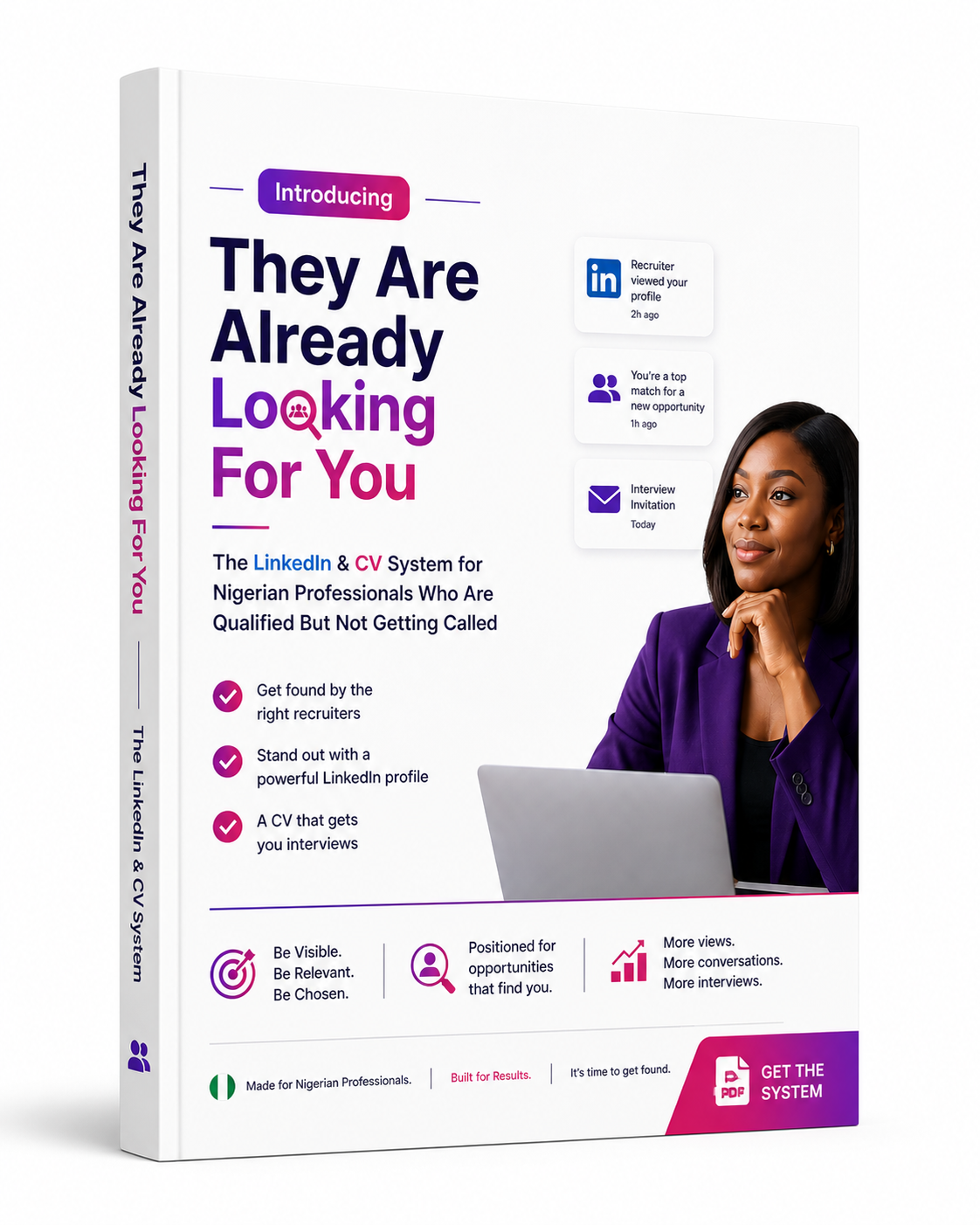
So I put everything inside one clear, step-by-step guide. Every page gives you something to do. No fluff. No theory. No recycled career advice you have already ignored. Just the system — with the exact steps, in the exact order, explained simply.
Introducing…
Share Your Experience